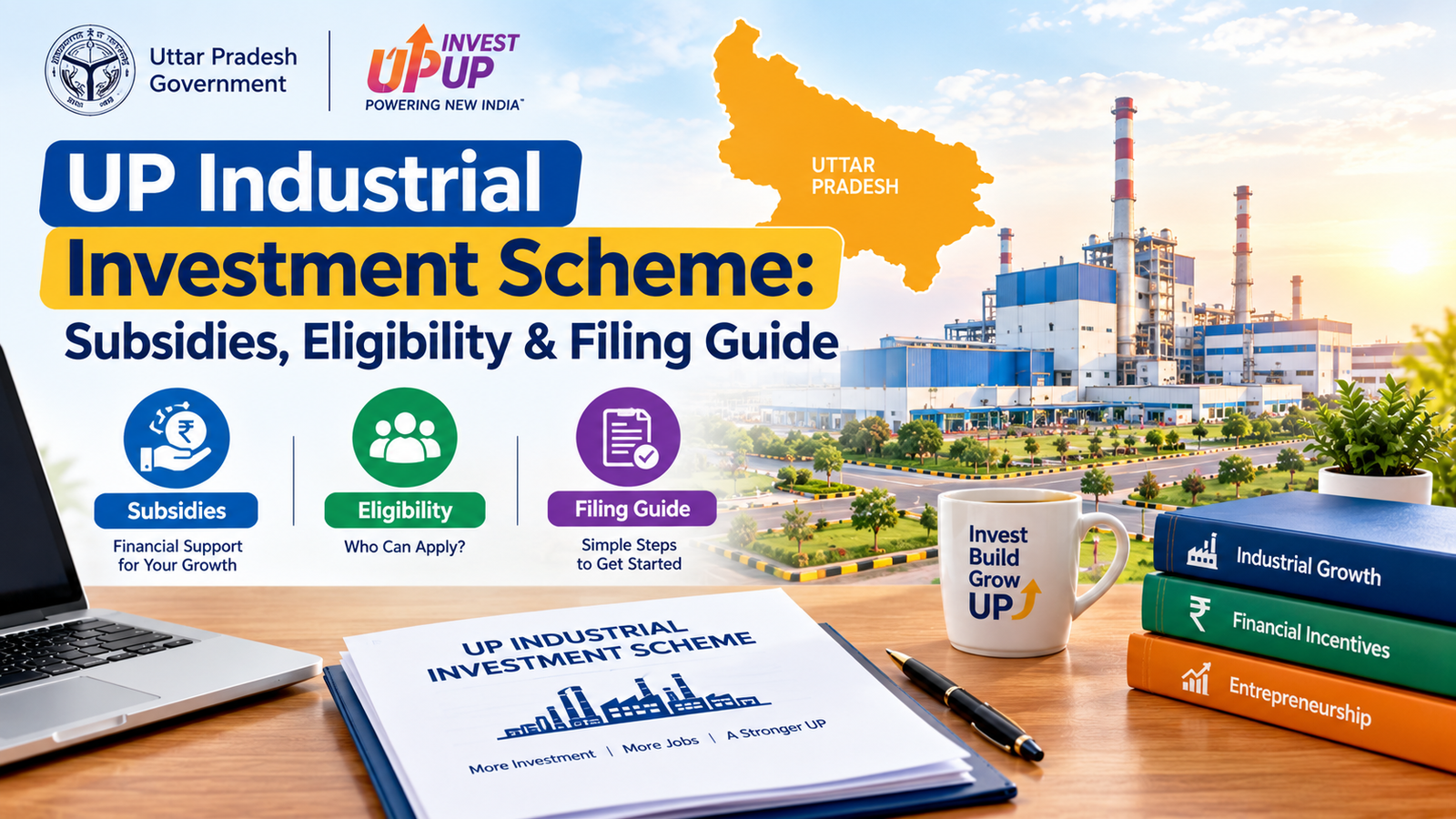
Navigating the UP industrial investment scheme has become a top priority for entrepreneurs, manufacturers, and corporate entities establishing facilities in northern India. Managed through Invest UP and the single-window Nivesh Mitra portal under the state’s industrial policies, this framework provides attractive capital subsidies, stamp duty exemptions, and infrastructure incentives to accelerate industrialization across Uttar Pradesh.
Whether setting up along the Yamuna Expressway near Jewar Airport, within UPSIDA manufacturing clusters, or across expressway nodes supervised by UPEIDA, understanding the subsidy structure before filing your application ensures you do not forfeit valuable financial reimbursements.
Here is an end-to-end breakdown of the incentives, regional slabs, eligibility thresholds, documentation guidelines, and step-by-step filing procedures.
Major Financial Incentives Under the Policy
The policy provides a structured multi-tier incentive model designed to offset heavy capital expenditure during the setting up and operationalization phases:
- Capital Investment Subsidy
The state offers capital subsidies calculated on Eligible Capital Investment (ECI), which excludes raw land acquisition costs:
- Bundelkhand and Purvanchal: Highest subsidy tier, offering up to 35% of eligible capital investment to drive development in emerging manufacturing belts.
- Madhyanchal and Paschimanchal: Moderate subsidy tier, offering between 25% and 30% of eligible capital outlay across central and western UP.
- Gautam Buddha Nagar (Noida / Greater Noida) and Ghaziabad: Competitive capital subsidies subject to policy caps, tailored for advanced technology, warehousing, and electronics manufacturing.
- Stamp Duty Exemption on Industrial Land
Acquiring land through state bodies or private purchase carries statutory stamp duty costs. The scheme offers tiered waivers or reimbursements:
- 100% Exemption: Applicable across Bundelkhand and Purvanchal districts, as well as for eligible women entrepreneurs statewide.
- 75% Exemption: Applicable across Madhyanchal and Paschimanchal districts (excluding Noida and Ghaziabad).
- 50% Exemption: Applicable for industrial plots acquired within Gautam Buddha Nagar (Noida, Greater Noida, YEIDA) and Ghaziabad.
- Electricity Duty Exemption
Commercial manufacturing units that commission operations are entitled to a 100% exemption on state electricity duty for a period of up to 5 to 10 years, depending on investment scale and regional category. - Interest Subsidies for MSMEs
For micro and small manufacturing units, the state provides reimbursement on term loan interest (typically 50% of annual interest, capped at statutory policy limits) for a period of 5 years, easing debt repayment schedules. - Additional Booster Slabs
Projects can unlock top-up percentage boosters on their capital subsidies by fulfilling specific developmental milestones:
Ecosystem Booster: For sourcing more than 40% to 60% of raw inputs from localized vendors within Uttar Pradesh.
Employment Booster: For generating high-volume direct employment or maintaining a high proportion of female workforce.
Export Booster: For enterprises exporting more than 25% to 50% of their total annual production.
Project Classification & Minimum Investment Thresholds
Incentives under the UP industrial investment scheme are categorized by total capital outlay:
- Micro, Small & Medium Enterprises (MSMEs): Covered under the UP MSME Promotion Policy, focusing on projects with fixed investments up to 50 Crores.
- Large Projects: Investments exceeding 50 Crores up to statutory mega thresholds.
- Mega & Super Mega Projects: High-capital projects exceeding 200 Crores to 500 Crores, evaluated directly by state-empowered committees for customized incentive packages.
Mandatory Eligibility Criteria for Applicants
To qualify for incentives under the UP industrial investment scheme, entities must satisfy core statutory parameters:
- Legal Entity Status: The applicant must be a legally incorporated entity, such as a Private Limited Company, Limited Liability Partnership (LLP), or registered partnership firm. Unregistered entities and sole proprietors face severe restrictions for industrial subsidies.
- Timing of Application: Crucially, applications for financial incentives must be registered and in-principle approved before plant and machinery procurement or commercial production begins. Subsidies cannot be claimed retroactively on completed projects without prior registration.
- Land Allocation Proof: Allotment letters, registered lease deeds, or title transfer deeds from authorities such as UPSIDA, YEIDA, Noida Authority, UPEIDA, or private industrial parks.
- Clean Financial Background: No active loan defaults or willful non-performing asset (NPA) classifications with financial institutions.
Essential Documentation and Detailed Project Report (DPR)
Filing an incentive claim requires submitting verifiable technical and financial documentation:
- Detailed Project Report (DPR): A thorough document outlining plant capacity, technology stack, proposed manufacturing process, implementation timeline, utility loads, and direct employment figures.
- Chartered Accountant (CA) Net-Worth & Expenditure Certificate: A formal certificate carrying a valid Unique Document Identification Number (UDIN), auditing actual or projected fixed capital expenditure.
- Bank Term Loan Sanction Letter: Evidence of financial closure, including sanctioned term loans, promoter equity contribution, and working capital limits.
- Regulatory Approvals: Valid Consent to Establish (CTE) from the UP Pollution Control Board (UPPCB), factory license blueprints, and local fire safety clearances.
Step-by-Step Filing Workflow on the Nivesh Mitra Portal
Step 1: Entity Profile Setup on Nivesh Mitra
Create a corporate account on the UP single-window system (Nivesh Mitra) and upload entity incorporation certificates, director DINs, and PAN details.
Step 2: Intent of Investment Registration (In-Principle Clearance)
Submit your proposed investment intent under the appropriate industrial policy module, detailing projected investment and district location.
Step 3: Document Upload and Departmental Scrutiny
Upload your detailed project report (DPR), bank appraisal reports, CA certificates, and land allotment documents. Nodal officers from Invest UP and the District Industries Centre (DIC) verify eligibility.
Step 4: Letter of Comfort / In-Principle Approval
Upon committee approval, the state issues an In-Principle Approval or Letter of Comfort setting out the sanctioned subsidy percentages and disbursement schedule.
Step 5: Commercial Operation Date (COD) & Subsidy Disbursement
Once civil construction completes and commercial manufacturing begins, authorities inspect the premises. Disbursals are released in annual installments directly into the company bank account via treasury transfers.
Planning to set up an industrial facility, cold storage, or manufacturing unit in Uttar Pradesh? MyLegalTax provides complete documentation audits, detailed project report (DPR) preparation, and portal filing support across Invest UP, Nivesh Mitra, UPSIDA, and YEIDA.
Advisory Desk: +91 99996 67262 / +91 87503 94151
Email: contact@mylegaltax.com | mylegaltax@gmail.com
Office: Gate No 2, H. No B, 179, B Block Rd, Sector 122, Noida, Uttar Pradesh 201316
(Note: MyLegalTax is an independent compliance and documentation advisory firm. We do not broker, buy, or sell land.)
Frequently Asked Questions
Question: Can an existing unit claim benefits under the UP industrial investment scheme?
Answer: Yes. Existing units undergoing substantial expansion, diversification, or modernization are eligible, provided the new capital expenditure meets the minimum expansion thresholds outlined in the policy.
Question: What is the main difference between Invest UP and Nivesh Mitra?
Answer: Invest UP is the premier investment promotion and facilitation agency of the government of Uttar Pradesh. Nivesh Mitra is the state’s digital single-window portal through which applications, license clearances, and incentive filings are processed.
Question: Are land purchase costs included when calculating capital subsidies?
Answer: In most policy categories, land acquisition cost is excluded from the Eligible Capital Investment (ECI) for capital subsidies, though land qualifies for direct stamp duty exemption.
Maximize Your Subsidies Under the UP Industrial Investment Scheme