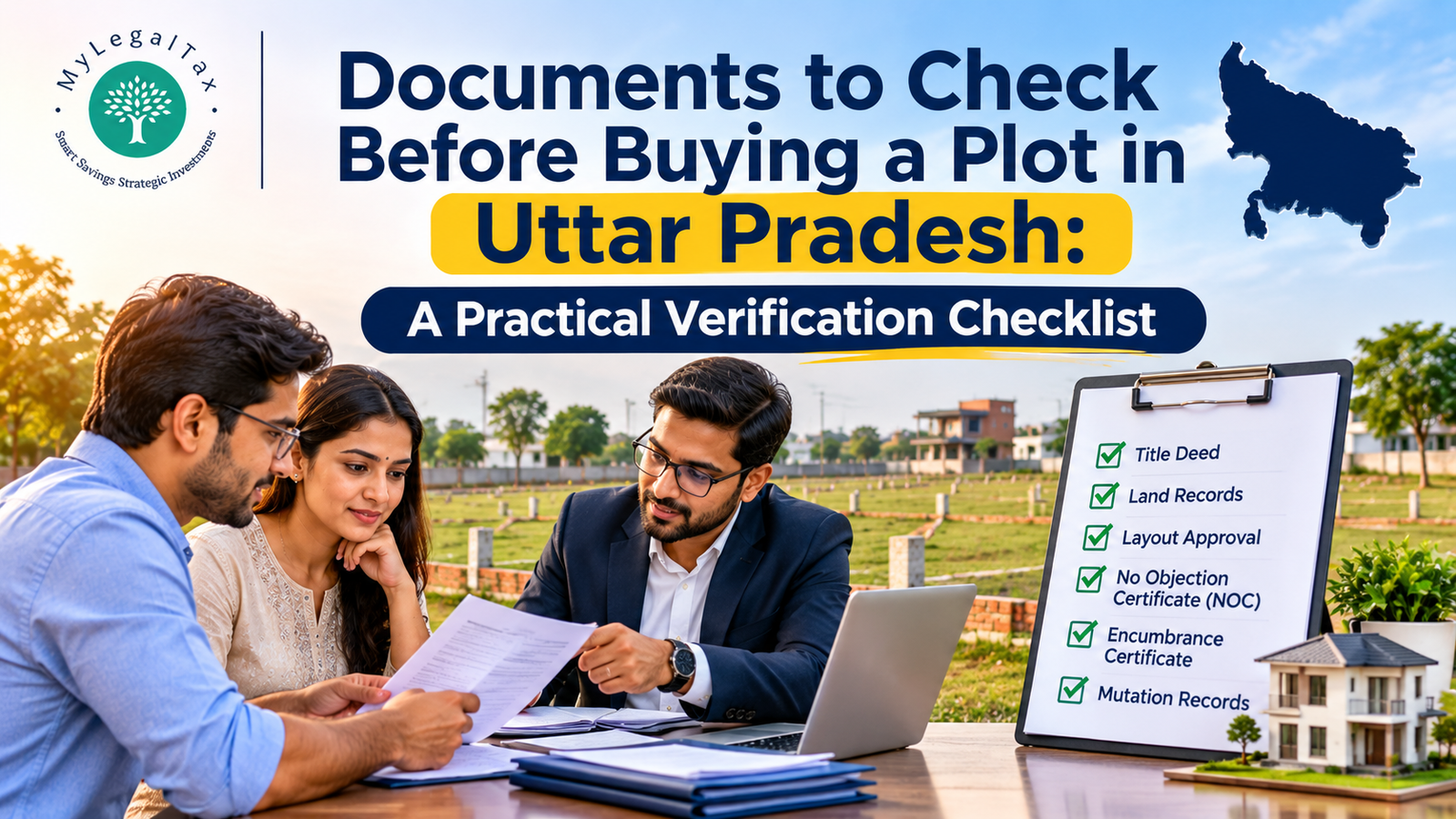
The documents to check before buying a plot in Uttar Pradesh fall into a handful of groups: the seller’s title chain, the land record on UP Bhulekh, the encumbrance certificate, the mutation entry, the land-use and approval status, and the possession and tax position. Skip any one of them and you can end up paying for land that is disputed, mortgaged or not legally saleable. This guide walks through each check, what it proves, the red flag to look for, and what is different when the plot comes from a development authority such as GDA, YEIDA, GNIDA or LDA.
This is general information, not legal advice. Procedures and portals change, so confirm the current process with the sub-registrar’s office or a qualified professional before you pay any advance.
Plot verification checklist at a glance
- Title chain: the sale deeds that show how the seller came to own the plot, usually checked for 30 years
- Land record: the khatauni and khasra entry on UP Bhulekh, matched to the seller’s name
- Encumbrance certificate (EC): proof that no mortgage or conflicting registered transaction exists, from IGRSUP
- Mutation (dakhil kharij): proof that the revenue record carries the current owner’s name
- Land use and approvals: confirmation that the plot can legally be used for housing or business
- RERA and developer status: for plots sold in a colony or project
- Possession, tax and utility dues: proof that the seller can hand over the plot and that nothing is outstanding
1. The title deed and the ownership chain
The title deed shows who owns the plot. But a single deed is not enough, because the seller’s ownership has to trace back through a valid chain of earlier transfers. Ask for every registered sale deed, gift deed, partition deed or inheritance document in the chain, and look for the oldest one, often called the mother deed.
A 30-year chain is the usual standard in property due diligence. What you are checking is simple: each seller in the chain had the right to sell, and the names, plot numbers and boundaries match from one document to the next.
Red flag: gaps in the chain, a transfer by someone who was not the owner, or a seller who offers only a power of attorney or an agreement to sell in place of a registered deed.
2. The land record on UP Bhulekh
UP Bhulekh (upbhulekh.gov.in) is the state’s official land records portal, managed by the Board of Revenue. It holds the revenue records, including the khatauni (the record of rights) and the khasra (the plot-level record). On the portal you select the district, tehsil and village, then search by khatauni number, khasra number or owner name.
Compare what you find with what the seller has told you: the owner’s name, the khasra number, the area and the type of land. They should agree.
Red flag: the khasra number is recorded as Gram Sabha land, meaning common village land. Gram Sabha land cannot be sold, so verify every khasra number before you pay an advance.
3. The encumbrance certificate on IGRSUP
Bhulekh shows the revenue record. The registration department’s portal, IGRSUP (igrsup.gov.in), shows registered transactions and provides the encumbrance certificate (EC). An EC lists the registered transactions on a property over a period, so it helps you see whether the plot has been mortgaged, sold more than once, or otherwise burdened.
Ask for an EC covering at least 30 years, or the full period of the title chain you are checking. If there is a mortgage on record, you need a written No Objection Certificate from the lender, and proof that the loan is closed, before the plot can be sold cleanly.
Red flag: an EC that shows a transaction the seller has not mentioned, or a mortgage with no closure papers.
4. Mutation (dakhil kharij) and name match
Mutation, called dakhil kharij in Uttar Pradesh, is the entry in the revenue record that updates the owner’s name after a sale or inheritance. Registering a sale deed does not automatically mean the record has been updated.
Check that the seller’s name appears in the current khatauni, and that the previous transfers in the chain were mutated too. After you buy, you will need to apply for mutation in your own name, so keep that in your plan.
Red flag: the seller’s name is missing from the record, or the record still shows a previous owner or a deceased person.
5. Land use, layout approval and authority status
Owning a plot does not mean you can build on it. Confirm what the land is classified as. If it was agricultural, ask for proof of the land-use change before it is used for housing or business. If the plot is inside a development authority’s area, ask for the approved layout or map and check that the plot appears in it.
Red flag: a plot in an unapproved colony, a layout that does not match the plot number you are being sold, or a seller who says approvals will be arranged after you buy.
6. RERA registration and developer checks
If the plot is being sold as part of a colony or project, check whether the project is registered on the UP-RERA portal, and match the registration number the developer quotes. In the NCR districts such as Noida, Greater Noida and Ghaziabad, also check whether the developer faces insolvency proceedings. A project can be registered and still have an active case against the developer, so the two checks are separate.
Red flag: no registration number, a number that does not match the portal, or a developer who avoids showing project approvals.
7. Possession, tax dues and utility dues
Before you pay, visit the plot. Confirm that it is physically where the papers say it is, that the boundaries match, and that nobody else is occupying it. Ask for the latest property tax, house tax or authority dues receipts, and for utility clearances where connections exist.
Red flag: an occupant who is not the seller, a boundary dispute with a neighbour, or unpaid dues that will become yours after the sale.
8. If the plot is from a development authority
Plots allotted by authorities such as GDA, YEIDA, GNIDA, LDA or UPSIDA come with their own paperwork, and the checks are different from a private sale. Ask for:
- The allotment letter, matched to the allottee’s name and the plot number
- Payment receipts and the payment schedule, to confirm all instalments are cleared
- A no-dues certificate from the authority
- The possession letter
- The registered lease deed or sale deed, where one has been executed
If you are buying from an existing allottee in a resale, find out what the authority requires for a transfer and whether permission is needed before the deed can be registered. Confirm this directly with the authority, because the rules differ between authorities and change over time.
Common red flags to stop and investigate
- The seller pushes for a quick token or advance before showing documents
- Only photocopies are offered, with originals unavailable
- The price is far below nearby plots with no clear reason
- The seller’s name differs across the deed, the record and the identity papers
- The seller refuses an independent verification
- A power of attorney is offered in place of a registered title
The order in which to do the checks
- Ask the seller for the full set of documents before you discuss the advance.
- Check the khatauni and khasra on UP Bhulekh.
- Download the encumbrance certificate from IGRSUP and read it against the title chain.
- Verify mutation and the name match.
- Confirm land use and approvals with the relevant authority or office.
- Check RERA registration and developer status, if applicable.
- Visit the site and confirm boundaries and possession.
- Only then agree the price, execute the agreement and register the deed.
When to get professional due diligence
A first read of the documents is something most buyers can do. A professional check becomes worth it when the title chain is long, when there are inheritance or partition documents, when the plot is an authority allotment being resold, when you are buying from another state or from abroad, or when the amount involved is large.
MyLegalTax is an independent advisory firm of Chartered Accountants and business advisors. We handle plot title verification, registry chain tracking and encumbrance checks for residential, commercial and industrial plots. We do not sell or broker land, and we are not affiliated with any government authority. Our role is to tell you what the papers actually say before you commit your money.
To discuss a plot you are considering, visit mylegaltax.com.
Frequently Asked Questions (FAQ)
Which documents should I check before buying a plot in Uttar Pradesh? Check the title deed and the full chain of earlier transfers, the khatauni and khasra on UP Bhulekh, the encumbrance certificate from IGRSUP, the mutation entry, the land-use and approval status, RERA registration where relevant, and possession and tax dues.
How do I check land records on UP Bhulekh? Open the UP Bhulekh portal at upbhulekh.gov.in, select the district, tehsil and village, and search by khatauni number, khasra number or owner name. Compare the owner, plot number and land type with what the seller has told you.
What is an encumbrance certificate and where do I get it in UP? An encumbrance certificate lists the registered transactions on a property for a given period, which shows whether it is mortgaged or has conflicting transfers. In Uttar Pradesh it is provided through the registration department’s portal, IGRSUP.
How many years of title history should I check? A 30-year chain is the common standard in property due diligence. Your lender or lawyer may ask for a different period, so confirm with them.
What is mutation (dakhil kharij) and why does it matter? Mutation is the entry that updates the owner’s name in the revenue record after a sale or inheritance. A registered deed does not automatically update the record, so you should check that the seller’s name is in the current khatauni and apply for mutation in your own name after buying.
Can Gram Sabha land be bought? No. Land recorded as Gram Sabha, which is common village land, cannot be sold. Verify the khasra number of the plot on UP Bhulekh before you pay any advance.
Do I need to check RERA for a plot? If the plot is sold as part of a colony or project, check whether the project is registered on the UP-RERA portal and whether the registration number the developer gives matches. In NCR districts, also check for insolvency proceedings against the developer.
What should I check when buying a plot from GDA, YEIDA, GNIDA or LDA? Ask for the allotment letter, payment receipts and schedule, a no-dues certificate, the possession letter and the registered lease or sale deed. For a resale, confirm the authority’s transfer requirements before the deed is registered.
Is online verification enough before buying a plot? Online portals such as UP Bhulekh and IGRSUP are a good first step, but they do not replace a site visit, a check of boundaries and possession, or a professional reading of the title chain.
Does MyLegalTax sell plots? No. MyLegalTax is an advisory firm that verifies documents and title. We do not buy, sell or broker land.